01
CompletedWorkshop 1 — Kick-off
- Dates
- 27–28 October 2026
- Location / format
- Online (Zoom)
- Host
- VuxAcademy AB
Partners align on objectives, quality criteria and working methods, and launch a baseline survey of participating teachers' starting AI skills. The survey results define what the first modules must cover.
Workshop 1 was successfully completed on 27–28 October 2026.
Summary
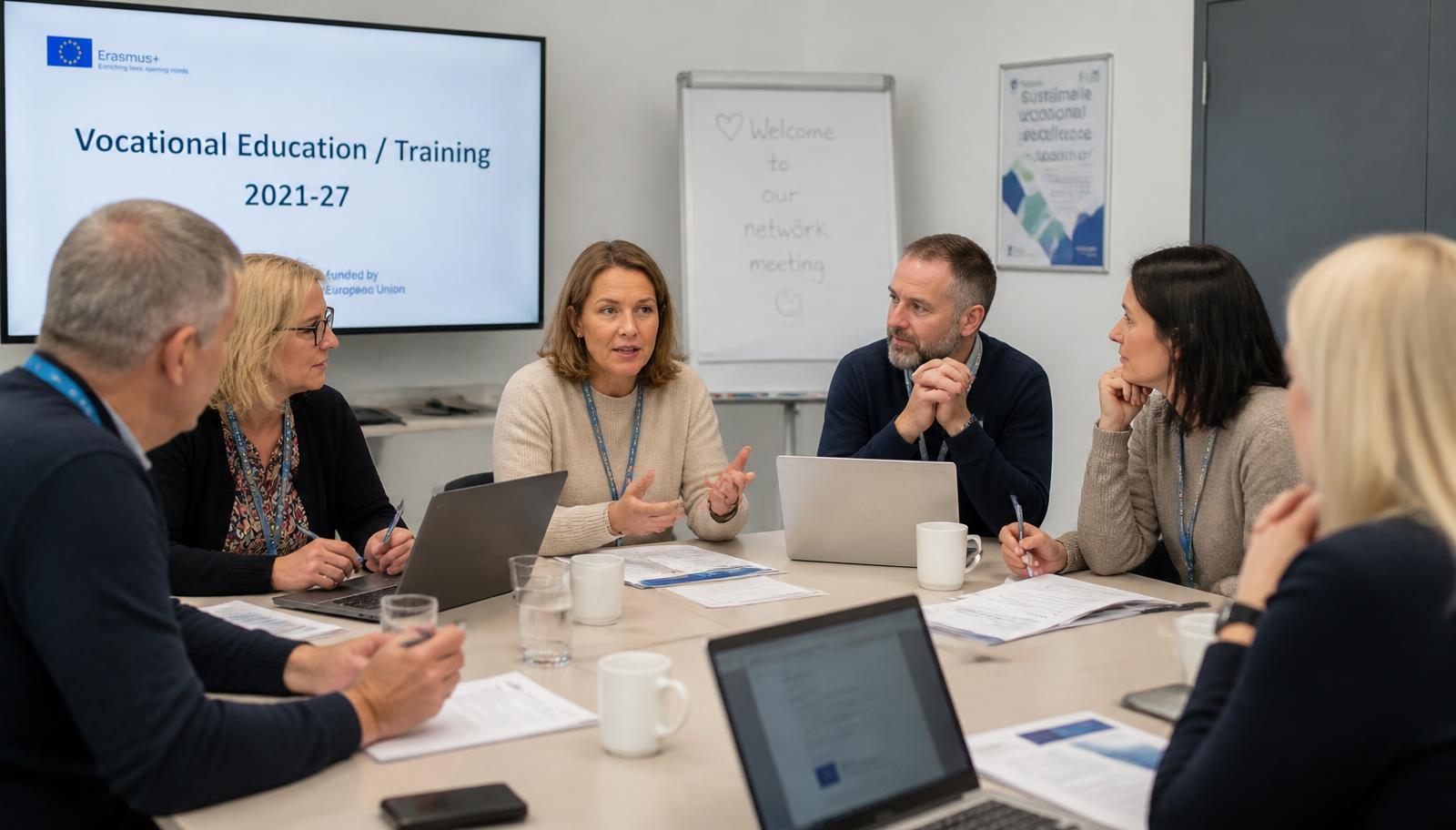
Workshop 1 — Kick-off (27–28 October 2026, online on Zoom)
The three partners, VuxAcademy (Sweden), EPRM (Portugal) and Colegiul Tehnic Ungureanu (Romania), met online for two days of work, together with invited AI expert(s). The workshop was organised in four blocks:
Block 1 — Shared ground
Each partner presented its role, its expertise in VET and AI, and its national context. The coordinator presented the full project framework: objectives, work packages, timeline, deliverables, dissemination, evaluation and administrative guidelines. The partners agreed a shared understanding of the main outputs: the AI4VET curriculum framework, learning modules, pedagogical guidelines and implementation strategy.
Block 2 — How we work
The partners confirmed roles and responsibilities, decision-making, communication and reporting routines, the risk register with owners, the peer-review routine, and compliance requirements from the grant agreement.
Block 3 — AI tools for VET teachers
The partners described the AI starting point of VET teachers in each country, identified priority skill areas (such as lesson planning, assessment, differentiation, feedback and student guidance), and reviewed AI tools on real VET teaching tasks using a shared review template. The invited expert contributed input on AI pedagogy and ethical AI use in education. The group drafted the first responsible-AI principles, covering bias, over-reliance, data sensitivity, GDPR and the EU AI Act.
Block 4 — Baseline, course blueprint and action plan
The partners validated the baseline teacher survey and common indicators, outlined the structure of the AI Upskilling Course with modules and learning outcomes, confirmed quality standards, and agreed an action plan leading to Workshop 2.
Key results
Shared project understanding; roles and decision-making matrix; communication and reporting routine; risk register v1; ranked priority skill areas; AI tool review matrix with shortlist; draft responsible-AI principles; validated baseline survey; draft course module map; action plan towards Workshop 2.